Nazarene Digital

A Nazarene Wrestling with Digitally Expressing the Great Commission

Category: general

  • Contending For The Truth In Love

    I was recently watching Gavin Ortland’s “Are Catholics Christians? Why Protestants Can Say Yes.” Setting aside the point of his video, and even (mostly) his ministry and conclusions, there was something he said that really resonated with me.

    …let’s conduct our disagreement going forward in a way that honors Christ where we contend for the truth, and we do so in love.

    Gavin Ortland

    Contend for the truth…in love. It seems so simple. Orland acknowledges that he falls short, as do we all.

    I’m part of a number of groups and people that stretch, shall we say, me. Okay, I flat out disagree with much of the content they share and propound. Yet, I have found it to be critical to my growth as a person, Christian, father, husband, and pastor.

    The language seen is “sinner”, “sin-lover”, “heretic”, “bigot”, “hater”, “hate-filled”, and most of this is from purported Christians to purported Christians. The presupposition of so many is that who ever the target of the person’s words are is coming from a morally or theologically wrong position. By wrong, I don’t mean in error or differing of opinion. By wrong, they put themselves in a place of condemnation and judgement of the other.

    The Hard Part

    By my words before, I could easily be accused of putting myself in the same place of condemning and judging others. I recognize that, but I’m also not sure what else I am supposed to do. Do I think any of these people will themselves be condemned to Hell (whatever iteration you presuppose)? Not because of their words, necessarily. It is still about their heart and their relationship with God.

    While I am glad, on one hand, that the church universal (dare I say, the church catholic) is publically discussion theology and ethics, I think we have neglected to contend for the truth in love.

    This is far more than LGBTQ+. There is MAGA and Trump, politics in general, Christians behaving badly (take that however you want).

    In my denomination, there has been public trials in regard to LGBTQ+ (granted, being publicized by the person on trial kind of minimized the publicization). There are ongoing issues with misuse of Pentecostalic gifts while condemning non-problematic ones (in other words, throwing the baby out with the bathwater). There are issues about how we view the Scriptures.

    My denomination long called itself a “big tent” denomination, but there are multiple camps trying to shrink the tent. My heart aches because too many are not contending for the truth in love, they condemn.

    I am currently in a space where I wonder if our denomination can get to a point of discussion without declaration. We are in danger of abandoning,

    Iron sharpens iron, and one person sharpens the wits of another.

    Proverbs 27:17 NRSVue

    Via Media

    My denomination draws heavily from John Wesley. One of Wesley’s phrases was via media. In other words, the middle way.

    Let’s set this in its proper context, and that is the Church of England. The Church of England had a philosophy of via media. It was walking the line between the Roman Catholic Church and many of the offshoots of Protestantism. As it became the official church of England, in many ways it ceased being the via media by the very nature of its societal and governmental (the CoE has ex officio seats in Parliament) position. It’s hard for many of my Church of the Nazarene friends to see that the Church of England used to be the via media. Granted, in many respects, the transformation of the Protestant Christian landscape, it seems kind of odd that the Church of the Nazarene is in any way a via media denomination.

    Yet, if we really want to hold onto via media as core to our identity as a denomination, then we need to relearn contending for the truth in love.

    Loving Contention

    How do we contend for the truth in love? First, remember Proverbs 27:17. That’s a good starting point. Some translations of this verse use friend as the sharpener. While that might not be accurate insofar as the Greek is concerned, perhaps that ought to be the place we begin our contention.

    The starting point of love, however, isn’t our fellow man, it’s God. Some argue, with good reason, that if we love our fellow man, we are loving God. When one holds onto an imago dei concept (that each person has the image of God in them), this makes good sense, except when it doesn’t.

    Except When it Doesn’t

    When doesn’t it make sense that loving a person is equal to loving God? When loving that person allows, permits, or (especially) endorses behavior that appears contrary to the Scriptures. Depending on who you are that reads that, you will come up with an issue that I must be implying. You’re probably right, as long as you recognize that whatever that one issue you inferred is one of many I implied. I won’t put any issues here, because there are far more than even the issues I’ve stated elsewhere.

    This continues to be the hard part for me, as it is for many pastors I know. We love our people. We see the many places their lives do not conform with the Scriptures. It’s not as if we are perfect, either. We, too, have aspects of our lives that need to be further conformed to Jesus, sometimes more desperately than our people.

    Just as we are to be held accountable, so too are all who are in the Body of Christ.

    Elevating Sin Over Love?

    There are plenty of issue where this happens. Perhaps elevating is overstating it. Perhaps. Yet, if we all “know” it’s wrong (whatever it may be), but nothing changes, and we continue to say nothing, then where does that leave us?

    We don’t want to talk about a person’s sin publicly (or at least not to identify a sin with a particular sin), which makes sense…except for public sin. We also don’t want to condemn. That’s above our pay grade (so to speak).

    Go and Sin No More

    Does this apply anymore? Do churches care about this? Do the people care about this? I want to say, “yes.”

    Where do toleration, acknowledgment, accepting, admonishing all start and end? Within those, where does love start and end?

    What if every Christian has to account for other people’s sins (in particular Christians) that they did not call out? This might seem extreme hyperbole, yet Ezekiel can be seen as the archetype of a Christian watchman (yes, I’ve seen that many places).

    We are to be a community, and a community holds its people to account.

  • Learning from Scientology

    Learning from Scientology

    My only real regret, is not having achieved what I said I wanted to—ending the abuses of Scientology.

    Mike Rinder (as quoted in One of Scientology’s Top Critics Dies at 69)

    I really know almost nothing about Mike Rinder. I know of his podcast and Emmy. I know of his partnership with Leah Remini and their quest about Scientology’s abuses.

    I say that because I haven’t listened to the podcasts, nor read his books. I skimmed through his blog. I had an inkling of something that seemed to be confirmed via Tony Ortega’s The Underground Bunker.

    …Rinder…as well as others who call …“independent Scientologists” still adhere to Hubbard’s ideas even as they reject Miscavige’s church.

    Mike Rinder on “The Hole” and How He Escaped Scientology, via The Underground Bunker

    From the first quote, I inferred that Rinder didn’t actually stop being a Scientologist. The Underground Bunker seems to confirm that. He was just trying to stop to abuses.

    A Familiar Refrain

    I have to admit, the first quote triggered the beginning of this post. I went looking for Rinder’s denial of Scientology, for that was implied by many of the articles about him, his podcast, and his Emmy.

    Yet, he wasn’t denying Scientology. He was, effectively, denying it’s domineering leader, David Miscavige. In particular, the strongarm controlling tactics that Miscavige, and that Rinder also drove at Miscavige’s behest.

    Those Blasted Deconstructionists

    Deconstructionists of the Christian faith, in particular the so-called Evangelical strain, seem kind of similar. To be clear, I read many of the deconstructionists. Some I agree with, some I don’t. Most of them are trying to faithfully live out a Christian faith, just without much of the non-biblical baggage (much of more cultural than biblical).

    While I do believe that Scientology is a false religion, having a detached view of the person in question (Rinder), helps me see the deconstruction happening in my own faith in a different way.

    Are the deconstructionists going to far? Maybe? Yet, far too many are—just like Rinder—deeply scarred by the emotional and spiritual abuse. It’s even worse that this happened in a faith that believes, “God is love.

    Who Drives The Conversation

    Reading the media (again, scanning it), it seems a presumption that Rinder was anti-Scientology rather than anti-Miscavige. Scientology and the press both seem to be operated from that perspective. It’s the same with Christian Deconstructionists.

    There is this bizarre trend regarding those speaking of deconstructionists that they are anti-Jesus, anti-Bible, even anti-Church. Yet, most that I’ve read (grated, that could be filtered by algorithm), have not walked away from a (dare I say) saving faith in Jesus Christ.

    What they did walk away from was ongoing hurt.

    Walking Away Vs. Walking Away

    Walking away from a or the church is not the same as walking away from the faith. They can have the same appearance, because often a person’s church experience is singular. In other words, the only church they know (or the one that has been the biggest part of their life whether by time or event) is the one they had to walk away from.

    Even their wider circles (especially in social media) probably revolve around similar behaving churches. In other words, their history is absolutely affecting their perspective of the church! If my only church experience is a bad one (as a long-term person, not a visitor), and it is reinforced when I see the other churches that church is connecting to also have bad behavior, why would I go to church? My assumption (yes, much emotional, but there is logic, too) is that all churches are bad.

    Yes, We Know We Suck

    That’s probably a bit much for some. The reality is that we use phrases such as, “the church is a hospital, not a museum,” because we know we suck. We are all hurt. We all hurt others with our hurt.

    We exacerbate the hurt. We create the hurt. We know this!

    Yet, when it comes to deconstructionists, we seem to deny or minimize it. They walked away. Since they walked away, we can tend to say, they left the faith.

    We can say, and most of them do say, they left the church. There are a lot of people who left the church. The church, for whatever reason, is often brutal.

    Is it because there we have to confront not only our own issues, but have grace toward others and theirs? Yes, we are to be kind, but we don’t seem to like being challenged about being unkind.

    Fallen Is A Reason Not Excuse

    We’re to be better, growing deeper in our relationship with Jesus Christ and as a result becoming more like Jesus through the power of the Holy Spirit.

    I don’t think there is a Christian (I hope) that does not affirm that sentence. Yet, we use our Fallen nature as an excuse for our bad behavior. It’s the reason, no question. It is not, however, an excuse.

  • No More Bringing People to Jesus

    In the evangelical Christian world, there is a common statement, “bringing people to Jesus.”

    Therefore go and make disciples of all nations, baptizing them in the name of the Father and of the Son and of the Holy Spirit, and teaching them to obey everything I have commanded you. And surely I am with you always, to the very end of the age.

    Matthew 28:19-12 NIV

    Go (per Jesus, Matthew 28:19) and bring (evangelical statement) seem a bit different to me.

    That “bringing people to Jesus” usually comes from a missionary perspective, or from those speaking about missions, puzzles me further. The “going” is thus transformed into bringing.

    Bringing Jesus To People

    Why don’t we say, “bringing Jesus to people?” Truly, foreign missions have been doing exactly that for generations, yet we still say, “bringing people to Jesus.”

    Does it matter? I think it does.

    For those entrenched in the four walls of the Western traditional model (of whatever tradition/denomination, not just the evangelicals), bringing implies (or is inferred) to bring people into “the fold”. However, what we are seeing now in the culture is that bringing people in isn’t working so well.

    Instead, we are having to engage people where they’re at. This does include digital (hence Nazarene.Digital), but it also includes Fresh Expressions and a myriad of other initiatives that are seeking to bring people to Jesus.

    As much good as programs such as Upward (soccer, basketball, cheer) have done in much the same vein, there is still more work to be done. Many of the Upward programs are about bringing people into churches, not bringing Jesus to people. A number of Upward programs (granted, this is anecdotal) are successful programs, but are held by churches that are not experiencing growth (numbers and baptisms).

    I have not answers, just an issue with a long-held and long-used phrase that needs to be re-thought and perhaps tossed.

  • No Perfect Witnesses

    No Perfect Witnesses

    In my denomination, there has been a lot of conversation regarding the Last Supper/The Feast of the Gods vignette 2024 Olympics Paris Opening Ceremonies. Perhaps conversation might be overstating it.

    There have been a lot of words, and I’ve shared the words of others.

    What is prompting this particular post is It’s Not What You Think It Is by Andy Lauer on the Holiness Partnership1 website.

    I have to admit that my first response was not overly positive. Lauer’s article kept circling in my brain, however, and I have come to the point of recognition that it is worth reading and pondering.

    Yes, it might be a tad over the top. On the other hand, I think that there was too quick of a response by those against the Opening Ceremonies, and by those (like myself) who felt the need to mitigate the expressed outrage.

    So, we are clear, I do think the Opening Ceremonies were kind of meh. I think it was an overreach that didn’t work out well. I also did find The Last Supper/The Feast of the Gods vignette tasteless, but its entire context within the fashion/catwalk larger vignette had already turned me off.

    Jan Hermansz van Bijlert’s Le Festin des Dieux (The Feast of the Gods ) does seem to be very much based on Leonard da Vinci’s The Last Supper. Van Bijlert is not unique in this as this seach page on Artsy shows. Thus, one of the claims many have made that the vignette wasn’t about The Last Supper might be correct on the surface, yet The Last Supper is very much a part of it.
    In his article, Controversy, Context, and Creativity in the Paris 2024 Olympic Games Opening Ceremony, John Squires preaches (he’s a pastor) about context, context, context. In response to much outrage, I shared his article with others, so that there was indeed some context.

    Squires is correct, context is key. The context is a broken and fallen world that does not have a functional relationship with God. Sadly, as much of the acrimony surrounding this vignette showed, it seems to apply to Christians, too.

    Many, such as myself, were responding to what was perceived has angry, hurtful, even hateful responses to the vignette. We saw this as damaging our ability to be effective witnesses for Jesus Christ. We understood that the world would first respond to Christian outrage with more outrage and shutting of doors to conversation.

    What we didn’t do, however, is ponder. Honestly, neither did a lot of the outrage against the vignette.

    We have been well trained to react, respond, react, respond. Maybe later we’ll think.

    We are not perfect witnesses. Those that tried to defuse the anger and those that were angry were actually not on opposing sides. That’s the part that really struck me with Lauer’s article.

    It’s not that we all don’t see a fallen world. It’s not that we all don’t see a world that is turned from God.

    Where people, such as myself, got a bit lost, perhaps, was that there is a distinct difference between trying to defuse, trying to understand, and trying to apologize. By apologize, I’m referring to the classic apologia, which seeds to defend or justify.

    It’s that last word, justify, where it seems that Lauer and others are rightly disturbed. Much of the defusing appeared (and may well have been) an attempt to justify the vignette.

    There are a number of conversations in the Christian world, including the Church of the Nazarene, where justification is equated to explaining, seeking to understand. This is vignette was one of them.

    Let’s be clear though. Squires, and many like him, used language that seemed more justifying than explaining.

    It’s not that I don’t understand that, but this impacts our witness.

    I get that there are many disagreements among and within the many Christian traditions (denominations and non-denominationals). I am becoming more convinced that it is not that we disagree, but how we disagree.

    Yes, there will be times where breaking of fellowship will occur, and I hope all parties involved are deeply grieved by that. I hope that the grief and sorrow is far outweighed by the sense of justification and righteousness.

    While I think this vignette is relatively minor, the hubbub that occurred around it is the point of greater reflection.

    We are imperfect witnesses for Christ. How we witness is very important. We may well have the right answers, but the right answers are only heard within relationships, and often not even then.

    As we come to the next outrage, let us think deeply if we are reacting and responding, or thinking, praying, and witnessing.

    1. The Holiness Partnership is a collective dominated by a group of Church of the Nazarene pastors who seem to be of a very traditionalist mindset. This can be good, as it ought to keep a balance to the progressive wing of the Church of the Nazarene. However, there is some concern, that the Holiness Partnership might have too much influence and control within the denomination, outsizing its numbers. ↩︎
  • The DARVO Christian

    In my social media circles, there is enough commentary, revelation, condemnation, accusation, pain, abuse being revealed and reported, that I really didn’t want to add to it. That was until I saw Tony Ray write, “DARVO is the Christian way“.

    DARVO is the acronym for deny, attack, and reverse victim & offender.

    In what Scriptural universe does DARVO equal Christian?

    The answer should be none. However, as many ministries and ministers have been rightly excoriated as a part of the #metoo movement and also since the modern revelation of predatory priests it sadly does seem to be the way of far too many Christians.

    I would prefer that Tony Ray would have written, “DARVO is the way of many so-called Christians.” It is more accurate, and for any Christian (including Tony Ray) to say DARVO is the Christian way should be a gut punch.

    That is likely Tony Ray’s point.

    The truth is that we have been trying to protect the image of “the church” and the local (or international) organization. This has actually tarnished our image. It can be reasonably argued that part of Jesus’ ministry was radical candor.

    The Pharisees, Sadducees, and scribes of Jesus’ time seemed to have some issues with that, according to the Gospel accounts. The church has much of the same problem.

    This really does seem to be regardless of tradition. Our Orthodox Ukrainian and Russian siblings argue over the war between Ukraine and Russia, including adding severely religious overtones. We watch the Roman Catholic Church dispute internally (yet, publically) around the words of Pope Francis and the various Cardinal groups. The Protestants with all their varieties argue over theology with some vitriol.

    The church, so to speak, is not perfect. It is the bride of Christ, but that still doesn’t make it perfect. Our veneer of perfection is all too often a lie we tell ourselves. We act as if we know we have the right answers, and then shut down others.

    The DARVO conversation has come up revolving around the SBC (Southern Baptist Convention) and its ongoing issues with moral failures regarding leadership, sexual immorality, financial immorality, plus the reality that many of these failures are more than moral failures, they are criminal.

    I will not list all of the failures that we are seeing in churches, but the reality is that there have been far too many. That there has been so little criminal prosecution is, well, criminal in and of itself.

    The desire to protect the reputation of the church (from local, to regional, to global) is understandable. What we are seeing, however, is not the protection of the church’s reputation, but its destruction.

    From what I have seen, people are behaving as if they are in a cult, rather than the hospital that the church is supposed to be. They are protecting leaders (disguised as protecting the church), rather than the innocent or the victim.

  • A Little Bit of Happiness

    A Little Bit of Happiness

    I was in a class last week about Holiness (John Wesley, American Holiness Movement, Church of Nazarene) taught Dr. Diane Leclerc, and we were reminded (for me, it might be even taught) that a “holiness” people seeking holiness (not in a self-righteous, judgmental, legalistic way FWIW) find happiness through the desire for and pursuit of holiness. It was an awesome class, and I took a way a lot from it. As is my norm, I’m still processing it.

    Then, this morning, I read this in the intro to Gary Thomas’ intro to his post Getting at the Core Message Behind Sacred Marriage’s, “What if God Designed Marriage to Make Us Holy More Than to Make Us Happy?” (I’m a free subscriber, so I only get the intro).

    I don’t mean that happiness and holiness are competitors. On the contrary, I agree with John Wesley that only those who pursue holiness will find true happiness.

    Gary Thomas, Getting at the Core Message Behind Sacred Marriage’s, “What if God Designed Marriage to Make Us Holy More Than to Make Us Happy?”

    Also, this morning (and what ended up driving this), I found this picture of a Bansky installation:

    Artwork by Banksy that reads, "Be with (with is crossed out) someone that makes you (you is underlined to emphasize) happy."

Found at: https://www.facebook.com/photo/?fbid=970830994687242

    There is some deep truth in Bansky’s art piece, and it is one of the issues that I continue to deal with (I even touched on it during my sermon this past Sunday). However, this also smacks of the “self-improvement” and “self-satisfaction” pursuit that seems to be anything but fulfilling and resulting in fulfilled people.

    In my own self-improvement inner work, I have come to realize that happiness and fulfillment are not necessarily the same.

    I have seen it proposed in non-religious contexts and by non-religious academics, that the current relentless pursuit of happiness is actually driving unhappiness. That doesn’t make sense at first.

    Think about it, though. As one pursues happiness, there is this weird inverse desire for greater happiness. Is happiness pursued ever really found?

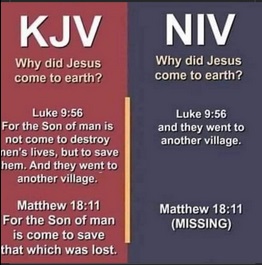
  • Your Translation Is Wrong!

    This was originally a Facebook post. I figured I might as well put it here, too.

    VERY CRITICAL ALERT!!!
    NIV was published by Zondervan but is now OWNED by Harper Collins, who also publishes the Satanic Bible and The Joy of Gay sex.
    •The NIV and ESV has now removed 64,575 words from the Bible including Jehovah, Calvary, Holy Ghost and omnipotent to name but a few…
    •The NIV and ESV has also now removed 45 complete verses. Most Of us have the Bible on our devices and phones especially OLIVE TREE BIBLE STUDY APP.
    •Try and find these scriptures in NIV and ESV on your computer, phone or device right now if you are in doubt: Matthew 17:21, 18:11, 23:14; Mark 7:16, 9:44, 9:46; Luke 17:36, 23:17; John 5:4; Acts 8:37…you will not believe your eyes.
    •Refuse to be blinded by Satan, and do not act like you just don’t care, Let’s not forget what the Lord Jesus said in John 10:10 (King James Version). There is a crusade geared towards altering the Bible as we know it; NIV, ESV and many more versions are affected,
    .THE SOLUTION: If you must use the NIV and ESV, BUY and KEEP AN EARLIER VERSION OF the BIBLE. A Hard Copy cannot be updated.
    All these changes occur when they ask you to update the app. On your phone or laptop etc.
    Please spread the word…

    Someone on Facebook who I won’t link to, but others abound with similar accusations.

    With the risk of offending some Facebook friends, I have to finally deal with this one. It keeps coming up in various places, and here, at least, I want to answer it.

    This is a purported “proof” that the NIV is corrupt. Let’s set aside the accusations toward Zondervan (the publisher), as it is Biblica (not Zondervan) that controls the NIV.

    First, let’s recognize that the KJV that most people read is not the original KJV published in 1611. If it does not say, “feede”, “poore”, “bestowe”, for example, it’s not the 1611 “Authorized Version”. There are the 1760, 1769, 1873, 2005 (supposedly returning to the “true” 1611 with modern spelling) versions. If I understand correctly, the 1873 version is the one most people are referring to when they say KJV.

    The KJV New Testament was translated using the 𝑇𝑒𝑥𝑡𝑢𝑠 𝑅𝑒𝑐𝑒𝑝𝑡𝑢𝑠, which was a compilation of texts gathered by Erasmus starting in 1516. This was the text that King James commanded be the only one used for the KJV, even though other manuscripts were out there. Erasmus (then King James) were the gatekeepers of the selection of manuscripts.

    Other translations, not just the NIV or ESV (which is probably the most KJV adherent modern translation out there), use more than 𝑇𝑒𝑥𝑡𝑢𝑠 𝑅𝑒𝑐𝑒𝑝𝑡𝑢𝑠 to compile, compare, select, and then (ultimately) translate. It is this process that provides confidence in the base aspect of the translation. That the 𝑇𝑒𝑥𝑡𝑢𝑠 𝑅𝑒𝑐𝑒𝑝𝑡𝑢𝑠 had a single person decided which manuscript (including the likelihood that he could not get access to some in other countries) is actually one of the huge red flags when it comes to modern translations.
    In the case of Luke 9:56 (chosen because they made a nice graphic about it), here is a short list of translations that match the NIV: the LEB (possibly the most scholarly conservative version), the REB, the CJB, the ASV (ties with LEB), NRSV, NRSVue, the Darby Version (from 1890!), the CSB, the CEV, the Douay-Rheims (from 1790!), ERV (1895).

    The accuracy of the NIV or ESV isn’t really the issue. What we have is, for many, like rock music was in the 80s for certain Christians (I remember seeing album and book burning in the news). This isn’t about wrong translations. It isn’t about the NIV, per se.

    I’m not sure what this person’s intent was (or those like them). I choose to think that they are trying to honor the Scriptures in this way. However, I believe this dishonors the Scriptures.

    As a pastor, I get to wrestle deeply with the Scriptures, understanding that we Christians have many manuscripts that were transcribed with mostly minor differences. While these differences are big when taken by themselves, in the entire context of the Scriptures, they are small. I’m glad when scholars find an obscure manuscript, because it almost always affirms the New Testament that we have. It’s not something of which to be frightened, or to scare other people about.

    My last thought, though, somewhat aligns with their conclusion. If you are a Christian, you should have at least one hard copy of the Bible. Not because the powers that be will change your Bible on the phone (though they can), but because it is a gift of God that is there (when in hard copy). When the power is out, your internet tanks, or should you (gasp) dare to disconnect from the monstrosity that the internet often is, a hard copy is there.

    John 10:10 (KJV 1611) reads, “The theefe commeth not, but for to steale and to kill, and to destroy: I am come that they might haue life, and that they might haue it more abundantly.”

    The fear that people such as this perpetuate steals and destroys. Fear is not from God.

    And, finally, for all my non-Christian friends, yes, we Christians don’t agree on all things (think of your own family and friends). We do believe, however, that Jesus is the Promised One, the Messiah. It is through him, and him alone, that we will spend eternity with him, as we (try) to change the world into looking more like Heaven on Earth (though we are, admittedly, not doing well in that area).

  • Rule of Life

    I’ve long been interested in the monastic life. Not sure I could handle it, honestly, but then again, God’s not calling me to it, either. That is normally a prerequisite. However, there are certain aspects of it that entice many of us, because we understand that there is indeed something very different about such a kind of life.

    A very brief history

    The Orthodox and Roman Catholic traditions have long upheld the importance of monastic orders. The Protestant traditions, on the other hand, killed off the monastic traditions. This even includes the Lutherans, whose founder, Martin Luther, was a monk.

    Today

    Modern and Post-Modern Protestants continue, however, to show a fascination with it (again, myself included).

    This is why Thomas Merton, Brother Lawrence, and others have books that are shared and read among Protestants, and sometimes even shared from the pulpit. Contemporarily, John Mark Comer, for example, has written popular books—The Ruthless Elimination of Hurry and Practicing the Way—that are very monastic in tenor. From the non-Christian monastic tradition, we have Jay Shetty’s Think Like a Monk. There are plenty of others.

    Where it appears

    In my smaller circles, in both the Church of the Nazarene and digital church expressions, there is a strong interest in the monastic life and way.

    The big draw, so to speak, seems to be the Rule of Life. However, the Rule of Life most seem to be referring to is their own Rule of Life, which is actually not very monastic.

    The founder of a monastic order writes the rules. The postulant, novice, and professed follow the rules. Yet, the dominant view is that we make our own rules. This submission (despite its baggage) to the rules is part of what makes a Rule of Life and the Order that defines it what they are.

    The Nazarene Rule of Life

    As I have looked at others’ Rule of Life, I came to the realization that The Church of the Nazarene has its own Rule of Life. It is called the Covenant of Christian Conduct.

    Now, I admit that the “Christian Conduct” in the title is often a struggle (including for me). Its implication (which I have had to confront) is that those who do not adhere to it are not Christian. This, of course, is false.

    When one reads the Covenant of Christian Conduct, one realizes that it is a Rule of Life. Historically, we’ve tied it to membership within the local congregation of the Church of the Nazarene.

    Becoming a Rule of My Life

    As a relatively new person in the Church of the Nazarene, I was not around when the Covenant of Christian Conduct was used as a goad (sometimes abusively it seems), which caused many to rebel against it. This is why Rule of Life may often not apply to a congregation (or even a denomination).

    The reality is, though, that we often choose to submit to rules that we do not like so that we can get along with others. In particular, we do so to get along in a particular community where we have found a semblance of home.

    When I came to the Church of the Nazarene, the remaining dominant rules were against smoking and drinking. Smoking wasn’t the biggest issue, as I had my dallying it with it long ago. Drinking was an issue, but it didn’t take me very long to determine that I would submit to this rule. Yes, submission was still a choice.

    The Hardness of a Church Rule of life

    While I have long come to grips with the Covenant of Christian Conduct (though, still not the title), I know many within the wider body of the Church of the Nazarene, and even among the clergy still struggle with it. Much of it has to do with how the Church of the Nazarene has tied it to membership. People want to belong to the community but not necessarily adhere to the Covenant of Christian Conduct.

    We, as a denomination, seem to have come to a point where we hold that it is our ordained and licensed clergy that must uphold the Covenant of Christian Conduct, while lay members do not. I’m okay with that.

    The truth is that every church, organization, and even culture (religious or not) has a rule of life. Culture’s rule of life is a lot more nebulous, and in the US it has a tendency to change very rapidly, defying the stability of a deep rule of life.

    I don’t know how to define it, but we generally view Rules of Life as if we must agree with all of it to submit to it. We actually lose a lot of its value when we make it about us as the individual, rather than us as the group.

    I know that people will continue to adamantly oppose the Covenant of Christian Conduct’s stance on alcohol, smoking (tobacco or marijuana), sexuality, and a myriad of other things.

    Rule Versus Covenant

    In an era of Home Owner Associations, covenant has lost much of its spiritual weight. The religious aspect has an understanding that God is in the agreement between parties, thus making it a 3-way agreement of life lived. Covenant remains valid withing a Christian church due to the religious covenantal understanding, but I’m not certain that even we in the Church of the Nazarene understand it that way any longer, even among our clergy.

    Supposedly, a covenant could not be amended either, but Home Owner Associations and the Church of the Nazarene amend their covenants. Thus, to be theologically more aligned with the concept of covenant, Rule is a better word for our association.

    They Do Not Like the Rules

    Last, but not least is the issue many pastors have, “people thing our rules are silly (or stupid or something), and won’t join the Church of the Nazarene.” As we watch church attendance decline, with or without our covenant in place; as we watch society’s fabric fray as its rules change at a shift of wind; as we question the future of the church as we know it; perhaps we made it too easy to get on and off the bus.

    I know that people don’t want to be known for what they are against. It is a philosophy I understand and with which I am in alignment. Yet, I do believe there is a big difference in being against alcohol and being for temperance, for example (as alcohol is a big cultural piece here in the Pacific Northwest). I get that people who like their alcohol and their culture).

    Semantics

    I know this is all about semantics, but we should not devalue semantics, as the nuances will create completely different understandings. I also realize that as many Christian churches are becoming generic what makes us different is now almost strictly about the preacher(s) and the music. As the Church of the Nazarene tries to also become more generic (to be more open and attractive), the Covenant of Christian Conduct may end up being tossed into the trash bin of history, or it may become something that makes us different…as long as we’re okay with being different.

  • One Place Is Me

    Since I am coming to that holy room,
             Where, with thy choir of saints for evermore,
    I shall be made thy music; as I come
             I tune the instrument here at the door,
             And what I must do then, think here before.

    Whilst my physicians by their love are grown
             Cosmographers, and I their map, who lie
    Flat on this bed, that by them may be shown
             That this is my south-west discovery,
             Per fretum febris, by these straits to die,

    I joy, that in these straits I see my west;
             For, though their currents yield return to none,
    What shall my west hurt me? As west and east
             In all flat maps (and I am one) are one,
             So death doth touch the resurrection.

    Is the Pacific Sea my home? Or are
             The eastern riches? Is Jerusalem?
    Anyan, and Magellan, and Gibraltar,
             All straits, and none but straits, are ways to them,
             Whether where Japhet dwelt, or Cham, or Shem.

    We think that Paradise and Calvary,
             Christ’s cross, and Adam’s tree, stood in one place;
    Look, Lord, and find both Adams met in me;
             As the first Adam’s sweat surrounds my face,
             May the last Adam’s blood my soul embrace.

    So, in his purple wrapp’d, receive me, Lord;
             By these his thorns, give me his other crown;
    And as to others’ souls I preach’d thy word,
             Be this my text, my sermon to mine own:
    “Therefore that he may raise, the Lord throws down.”

    “Hymn to God, My God, In my Sickness” by John Donne

    I ran across this poem through Biola University’s The Lent Project for April 3rd. What struck me was, “Paradise and Calvary, Christ’s cross, and Adam’s tree, stood in one place; Look, Lord, and find both Adams met in me…”

    Not sure why this stuck out, but the truth of that does seem to have some echoes in Paul’s words:

    I do not even acknowledge my own actions as mine, for what I do is not what I want to do, but what I detest. But if what I do is against my will, then clearly I agree with the law and hold it to be admirable. This means that it is no longer I who perform the action, but sin that dwells in me. For I know that nothing good dwells in me—my unspiritual self, I mean—for though the will to do good is there, the ability to effect it is not. The good which I want to do, I fail to do; but what I do is the wrong which is against my will; and if what I do is against my will, clearly it is no longer I who am the agent, but sin that has its dwelling in me.

    Romans 7:15-20 REB1

    Donne is not the same as Paul, however. I sense a different (still similar) tension. The recognition/realization that we are not fully one (Calvary/Adam versus Paradise/Jesus) clicks for me.

    The imagery of a tree will helps to root this as an internal tension that we all struggle with. Both aspects (or four if you want to divide them further), remain true in us until we are in Heaven with Jesus.

    1. Scripture quotations taken from the Revised English Bible, copyright © Cambridge University Press and Oxford University Press 1989. All rights reserved.  ↩︎